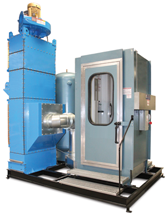
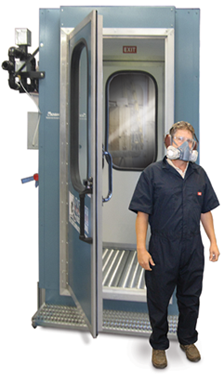
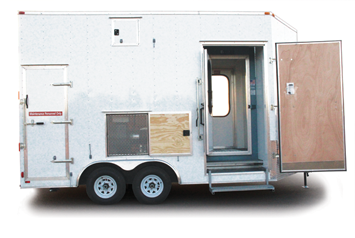
The Clothes Cleaning Booth and System is a quick and effective way
to clean a worker’s dirty work clothes without exposing
the worker, co-workers, or the work environment to
elevated dust levels.
A US Bureau of Mines report has documented a 10-fold
increase in a worker’s dust exposure due to dusty work
clothes. It was found that once clothes become
contaminated,
they are a constant source of respirable dust until
cleaned. Taking these dusty clothes home to be cleaned
also exposes the person washing these clothes to unsafe
levels of respirable dust.
A worker, without
removing his clothing or his PPE, can step into a
specially designed clothes cleaning booth and within 18
seconds have almost all visible traces of dust removed
from his/her clothing. This eliminates their exposure to
this dust hazard.
In other applications, the clothes cleaning booth is an
excellent way to maintain the cleanliness within a plant
and the area where workers keep their work clothes.
Developed to comply with all applicable federal
regulations,
the clothes cleaning booth utilizes compressed air
exiting a
manifold of nozzles to clean a workers’ clothing in 20
seconds.
The only other approved* method to perform clothes
cleaning
in industry is to have workers vacuum their clothes
using a
HEPA filter system. This method is difficult and time
consuming, and in most instances, not very effective.
The use of a single compressed air hose is preferred by
most workers but is strictly prohibited by law and
usually creates a significant dust cloud in the work
environment.
Some
of applications for use:
Industrial
Minerals Processing
Silica
Processing
Power
Generating Plants
Aerospace
Manufacturing
Aerospace
Reconditioning
Asbestos Removal
Powder
Coating Processes
Copper
Smelting Operations and Plants
Mineral
Mining Operations
Paper
Manufacturing and Processing
Coal Mining
and Processing Plants
Fiberglass
Boat Manufacturing & Repair
Nuclear
Lead
Recycling
Metal
Refining
Healthcare
Industries
Quarries
Cement
Processing Plants
Wood Working
Companies
Textile
Plants
Construction
Sites
Auto
Repair Shops
and Many,
Many More!
Examples of Possible Configuration of
Exhaust:
VENT TO ATMOSPHERE: in many
applications, i.e. quarries, it may
not be necessary to collect the
dust. Venting it back to atmosphere
may be sufficient.
EXHAUST TO EXISTING DUST COLLECTION
SYSTEM: The typical in-plant
installation will require at least
2000 cfm of excess capacity in the
existing dust collection system,
i.e. bag house.
DEDICATED DUST COLLECTION: The use
of our optional Dust Collection
System that would be dedicated to
the clothes cleaning system. If the
quantity of dust to be collected is
small a
pleated filter. Penum may suffice.
The Clothes Cleaning Booth was
developed through a cooperative research effort
between the NIOSH (National Institute for Occupational
Safety and Health) and Unimin Corporation, an
industrial minerals mining company. NIOSH is part of the Centers for Disease Control
and Prevention (CDC) in the Department of Health
and Human Services. More details of this project
and a video are at their website. (www.cdc.gov/niosh)
(*MSHA Approval Pending)
SPECIFICATIONS:
Booth Dimensions 42”1/2 x 52 1/2” x
96” outside Total footprint depends
upon dust collection needs.
42” x 48” x 84” inside. Open Grating
Floor.
Door Window, Light fixture,
Electrical Control Wiring, Control
Panel, Safety Valves, Actuators,
Timers, Air Spray Manifold, and
Operating Instructions are included.
Air Reservoir Tank and Blower are
also included.
Self-Contained Dust Collection
Systems and Air Compressors are also
available for stand-alone units.
PERFORMANCE:
The Clothes Cleaning Booth
discharges 125 cubic feet of regulated air in
18 seconds at 30 psi each cleaning
cycle.
A 240 gallon Air Reservoir Tank holds enough air to complete one
cycle. Recharge time depends upon
the plant air system capacity. The
air tank also serves as an
accumulator to dampen the effects of
discharging this high volume of air
on the plant system.
The time it takes one worker to exit
the booth and the next worker to
enter and start the process will
determine the wait time (if any)
until the next cycle starts.
The air needs to be relatively clean
coming out of the nozzles.
Therefore, if using existing ‘plant
air, it may be necessary to add
filtration and a dryer to the
system.
Click on photo for larger view:
Single Door
Design
Interior with Nozzle Manifold
Optional Skid Mount
HEPA Filter
Cartridge
Optional
Dedicated Dust
Collection System
Did you
know that the Clothes Cleaning Booth is used
Internationally, and yet different countries call it
by different names? They're known as
Clothes Cleaning Booths, Clothes Cleaning Systems,
Decontamination Booths, Dust De-Contamination
Booths, NIOSH Booths, Cleaning Systems, Air Showers,
Compressed Air Showers, Hygiene Booths, and
Contamination Cleaning Booths and even "Soot
Suckers"!
We can Customize the Clothes Cleaning Booth System
to
work In Your Specific Application
Can be fitted into your present operation
or sold as a complete Cleaning System.
Developed to comply with
all applicable federal regulations, the clothes
cleaning booth utilizes
compressed air exiting a manifold of nozzles to
clean a workers’ clothing in 20 seconds.
The only other approved* method to perform clothes
cleaning in the mining industry is to have workers
vacuum their clothes using a HEPA filter system.
This method is difficult and time consuming, and in
most instances, not very effective.
The use of a single compressed air hose is preferred
by most workers but is strictly prohibited by law
and usually creates a significant dust cloud in the
work environment.
The applications for the clothes cleaning booth are
numerous. If you have workers in a dusty
environment., you may want to consider this method
of cleaning their clothes.
Two Models Available:
CCB 1 (Single Door)
CCB 2 (Two Door Walk
Through)
Model CCB
1
Typical Installation includes:
Clothes Cleaning Booth.
240 or 400 Gallon Air Tank.
Booth, Blower and Tank are available Skid
Mounted for quick repositioning of the
system.
Compressed Air Source.
2000 cfm Blower Vented to Atmosphere or Dust
Collection System.
Standard Voltage 230 v 3 phase
w/neutral or 460 3 ph. Specify voltage.
Video
Demonstrations
Content on this page requires a newer version of Adobe Flash Player.